Wednesday, 4 February 2009

smc Pentax DA 14mm F2.8 ED lens samples

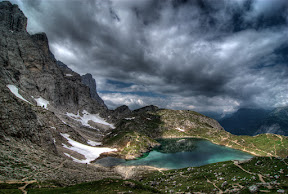
I have uploaded two F-stop series of the original jpg's made with the smc Pentax DA 14mm F2.8 ED lens. These jpg's are AS IS, as they came out of the camera. All stops are covered, going from the lowest (F 2.8) to the highest (F 22)
The photo samples are available on the following link:

Pentax smc 14mm f2.8 ED

Friday, 4 July 2008

A HDR for comparison

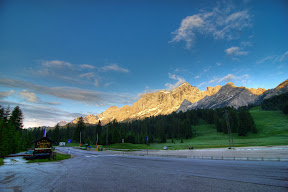
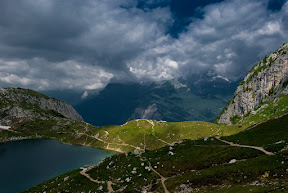
I also made HDRs, and so I am also showing that, for comparison. First non-HDR, made from the middle exposition. Second HDR, + and - 1 shutter brackets.


Look at how the sky is pixelated in the HDR.

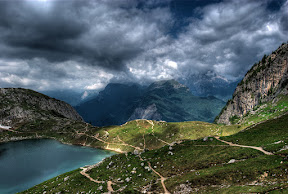
Pala Favera has no . Normally, this would be the situation when one would want a HDR: early morning, sun is coming up, part of the landscape is lit, but otherwise it is in shadow. But this pic is not so good - although it can give back the feeling of the shadow over the road.

Toying with LDR and HDR

I have been toying with the LDR technique, and I have got some nice results.
LDR (low dynamic range imaging) is like HDR (high dynamic range imaging), but here one RAW pictures is used instead of more expositions (usually three in HDR). The application (I was using Photomatix 3) offers the option to automatically create an LDR image directly from a raw original, profiting of the wider range of information available in the raw.
Later, I was trying to toy with saturation in the same photos to make the most out of them. It is not that I am extremely fond of saturated colors, but here I needed to put some colours in the pics because otherwise they were flat. And also, this will allow a comparison: what you can have with LDR and with a simple Lightroom edit.

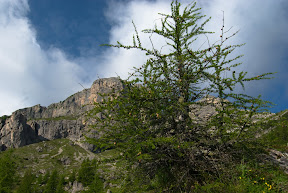
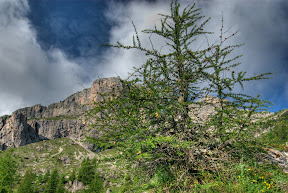
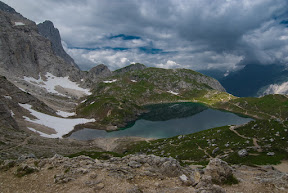
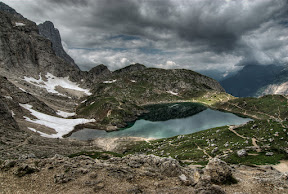
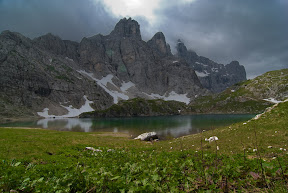
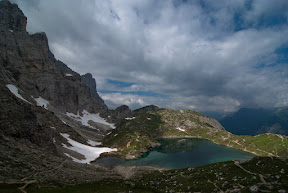
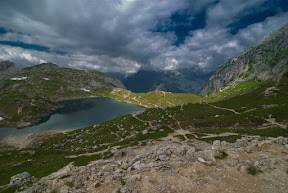
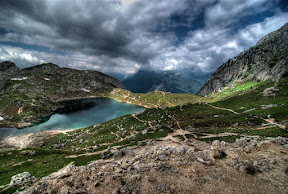
Here are some paired photos for comparison - first is regular, second LDR.

When the sun was not yet shining:


----


Some sun coming out - I think these are very successful LDRs:


---


Here I prefer the normal version - there is a lot of sun on the green grass:


Friday, 4 April 2008

perfecyello.xxl meets PENTAX smc DA 16-45mm f/4 ED AL

I have uploaded two F-stop series of the original jpg's made with the 16mm wide angle of the PENTAX smc DA 16-45mm f/4 ED AL lens. These jpg's are AS IS, as they came out of the camera. All stops are covered, going from the lowest (F 4.0) to the highest (F 22)

Here is the album at Picasa:
http://picasaweb.google.com/perfectyello.xxl/PentaxSmcDA1645EDAL

1.
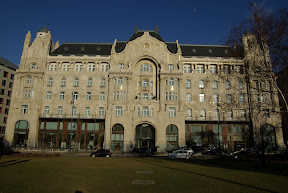
A series made at the Gresham Palace (Grasham palota), right in front of the Chain Bridge, Lánchíd (now a prestigious Four Seasons hotel).
Származási hely: Pentax smc DA...


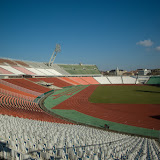
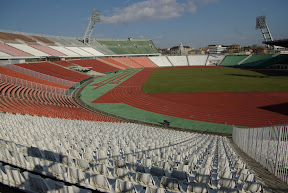
2. The other is the Puskás Ferenc Stadion:
Származási hely: Pentax smc DA...


I took these pictures at the beginning of February, on two unusually sunny days, when there was also huge wind, which gradually covered the lens with dust particles at Puskás Stadion.

Tuesday, 20 November 2007

Clone tool discovered in Lightroom

There is a tiny dust particle on my CCD. Well, you may all know this, but after having used Lightroom for some time, I have discovered that there is a Clone/Heal tool which allows removing signs from dust on the CCD or the lense. This is just to let you know. Good news.

As is

I decided some time ago that I would rescan my negatives already scanned with the Epson Perfection 3170 Photo scanner because I realized that batch scan in the Epson 3170 simply cuts off the edges of all pictures. I was thinking of my great art that inhabits the entire picture space and how it was brutally distorted by this machine and I made the decision to rescan everything.

Besides, I have recently bought an Epson Perfection V700 Photo scanner because I had the impression that my earlier Epson Perfection 3170 Photo scanner started to perform badly.

(It was pixelating photo scans, see my earlier blogpost about that.)

Now that I have been using Epson V700 for a while, I have really come to rescan some photos. I have given up the thing about the edges (in Epson V700 the plastic holder is such that it even covers the edges so finally why bother...). Rescanning these pictures was really the acte gratuit, the meaningless action, so probably I wanted to find some meaning, and this meaning I found in sharing.
Here we go, lo, a comparison of the very same slide scanned with both scanners.
Each scan is provided AS IS in 3200 dpi resolution over at my Picasa account, just click on the thumbnails and enjoy the view. But also beware, as they are above 60MB each.

These are 100 ISO Fuji slides taken with a Canon Eos 300 and scanned with 3200 dpi:
Epson 3170, 24-bit colour
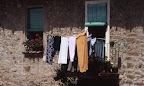
Epson V700, 48-bit colour
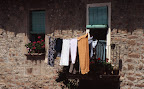
Epson 3170, 24-bit colour
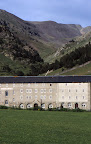
Epson V700, 48-bit colour
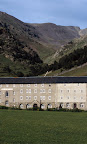

Any difference? Images of V700 are more vivid. The Epson 3170 is said to have something like a white veil on all pictures.
Post to del.icio.us

Saturday, 17 November 2007

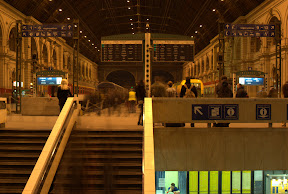
Keleti yellow light revisited

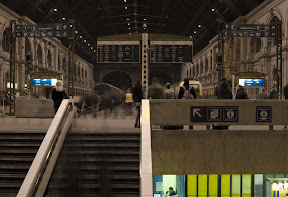
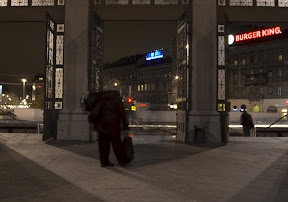
This was the original photo taken in yellow light:


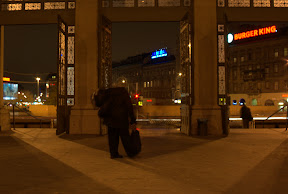
I manipulated it by decreasing the Saturation of Orange and adding some extra saturation for the Blue. (I also added some extra Contrast and Brightness)


Then B. came up and tampered with White Balance.
Interestingly enough, he picked a spot which was white (to our eyes at least) - it was a brightly reflected, burned spot on the back of the dustman in the yellow overcoat in the middle of the photo).
This made the photo even less orangy than after my manipulation. What is more, the blues also came back.
Then we started experimenting with the different colours. Extra saturation for the yellow would make the panels underground as well as the yellow trains regain original colours. This was also an effect pleasant to the eye.
We then took back from the Luminance on the blue spot of the train's neon sign. This drastically effected the Luminance of Blues (-67). This was useful for making the shining blue surfaces, lit by neon lights, come back to reality, and become less bright (less overexposed) and more contrasted (which also means sharper).
Finally, the saturation of this spot was pushed up a tiny little bit.

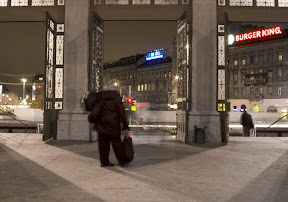
Here is the result:


Post to del.icio.us

All the photo communities of the web

It seems to me that I am trying them all:

Picasa
http://picasaweb.google.hu/perfectyello - Where I normally upload photos related to this blog.
http://picasaweb.google.hu/perfectyello.xxl - Where I upload oversized pictures (for testing objectives) that I would like to share with the photo community.

Panoramio
http://www.panoramio.com/user/554888

IndaPhoto
http://indafoto.hu/perfectyello

Flickr
I have several accounts on Flickr.

And last but not least, the Dreamstime Stock Photography site:
http://www.dreamstime.com/perfectyello_info

Monday, 12 November 2007

Yellow light from light bulbs at Keleti

It turns out that yellow light is actually orange. Saturation of orange was decreased to around minus 80 on these photos taken at Keleti train station in the evening.

Some extra saturation was added for the red...

...for the blue:

...for the green:

These pictures are almost black and white... or sepia.
Actually, it is hard to tell whether this is more natural. After all, light was awfully orange-yellow at Keleti.

And finally, imagine there was more light in Keleti at this night, let the white stones shine white...

Post to del.icio.us

Thursday, 8 November 2007

Is it or is it not a problem?

Is it or is it not a problem when somebody enters your photo at the bottom right corner? I definitely cannot decide. It might as well be interpreted as dynamism.

Un-sharp is clever

Normally, I like sharpness in my pictures. The Carl Zeiss Jena Flectagon 20mm f4 I was testing with my M42 adapter on the Pentax K10D turned out to be particularly unsharp - to an extent unimaginable.
Closer pictures are however sharper.
That is how the idea of this double world with the blurred underworld of humans and the sharpness of abstract signs above it occurred to me. Also, this seems to be a picture that works much better in black and white.


I have seen something very similar by Zoltán Vancsó, where things you would normally not compose in one picture fit quite well together. Like in this picture, for example

It may well be that technical perfection is a subjective term, a good picture always depends on what you make of your tools. (How clever, uhh.)

400 ISO becomes black and white film grain

I made this photo with the 20mm Flektagon which is not particularly sharp (see my other post about this). I turned this photo grayscale, underexposed it some, and put some extra light (Fill Light), and finally pushed up contrast. The result is a lot of film grain.
Also look at other BW photos I created this way: Black and White

I can black and white

... if I turn the photo grayscale and add some extra contrast.


Post to del.icio.us

Underexpose the sky

I tampered with the exposure in Lightroom, underexposed this picture about 0,8 as compared to "natural", and also put some contrast because the lens I used (the Carl Zeiss Jena Flectagon 20mm f4) is extremely soft and contrast is said to come in handy when a picture is soft.
The reason for putting the picture here is because the sky became pixelated to the eye in the smaller versions: there are amorphous blocks of dark blue.

Sunday, 4 November 2007

Pentax SMC-DA 18-55 distortions at wide angle

Here is a test picture made at the extreme 18mm wide angle with Pentax SMC-DA 18-55 that comes in the most basic kit for Pentax K10D and some earlier Pentax cameras.

Distortions appear at the edges. Extreme flare, an important decrease in resolution. Probably there is also vignetting but that cannot be seen on this picture.

The picture is uploaded in the original size to Picasa.

Saturday, 3 November 2007

On the utter unintelligence of scanners

The following is the documentation of
  • a, a bug
  • b, the catastrophic inbuilt intelligence
  • c, heuristic un-intelligence
of my scanner used for scanning photography, the Epson Perfection V700 Photo.
I earlier used an Epson Perfection 3200 Photo scanner, and it did the same.

Surfaces of homogeneous or almost homogeneous colour are misunderstood by the scanner in big single-coloured blocks, while fine transitions of shades within them appear pixelated.

No idea why, actually, any explanations are welcome, mine is just a documentation of the thing.

Fuji 800 Color Film:


Black and White Ilford 100:

Post to del.icio.us

SMC Pentax-M 50mm f1.7 meets the cat

SMC Pentax-M 50mm f1.7 is beautifully sharp in close pictures. This is a link to the original 10Megapixel photo I uploaded to Picasa:

Cat photography may be generally considered ridiculous but the tiny hairs on a cats body are a great test of sharpness.
Post to del.icio.us
Too much shadow

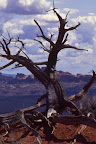
I made this photo of a dead tree in Utah, and I really like it so I would not let it go.
When I put the contrast up so that the background would be colourful and more sharp, the shadows on my dead tree all became black, without any detail.

So I had to restart my postprocessing. First did an extreme backlight correction to regain some of the shadowy parts, than applied contrast and colour manipulation for the background (blue sky+mountains and purple mountain range). Not all perfect, but shadows look better.


The full frame version of this picture may be purchased and downloaded here.